St Marnock Square and its surrounding area has gone through many changes over the centuries, often playing a pivotal role in the history of Kilmarnock.
The Tom Lightbody mural depicting Lady Ann Livingston Boyd, Countess of Kilmarnock, showcases just one episode in the area's rich history.
Here we outline more about the buildings and lives lived in the surrounding area, including the:
- origins of St Marnock
- former King Street Church
- land at St Marnock Square
- surrounding streets such as St Marnock's Street, Titchfield Street and King Street
Who was St Marnock?
There is very little reliable information about St Marnock.
J.C. Cooper’s Dictionary of Christianity (1996) states that it is thought he was born in Ireland in the 6th century AD. As a disciple of St Columba, who lived from 7 December 521 to 9 June 597 AD, St Marnock was a monk on the Isle of Iona before leaving the monastery to become a Missionary Bishop on the Scottish Mainland.
It is believed that he died in 652 AD and that his remains were interred in Kilmarnock. Reputedly his head was kept in the town where, after being washed every Sunday, the water was given to the sick to drink as a miraculous cure.
As a saint he gave his name to Kilmarnock - with the gaelic word "Cil" meaning cell, church or burial place being added to his name.
When did St Marnock live?
There is some dispute about exactly when St Marnock lived.
Archibald McKay’s ‘A History of Kilmarnock’ (1848) says that some writers state today’s Kilmarnock was the residence of a St Mernoc or Marnock as far back as 322 AD and that here, he founded a church and therefore likely the town, as people seeking or receiving his holy instructions would settle near him.
McKay goes on to say this very early date is doubtful and it is more probable he settled here at the end of the sixth or beginning of the seventh century when some of the early teachers of Christianity, educated under St. Columba, established places of worship.
He states:
‘The origin of Kilmarnock, like that of many other towns of importance, is involved in considerable obscurity, and scarcely anything illustrative of its ancient history can be gathered… That it is a place of great antiquity however, seems to be the general opinion.’
Religious devotion was always a strong element in the evolution of the town, with churches and faiths playing a big part in the St Marnock Square area.
Origins of King Street Church – the congregation – a legacy of dissent
In 1798, a group of worshippers broke away from Riccarton Church, rejecting the patron's chosen minister.
United by their commitment to choosing their own leaders, they initially gathered in a modest barn with no flooring or heating, each bringing their own chair.
This determined group laid the foundation for what would become the King Street Church congregation in Kilmarnock.
A place of their own - the first church in Kilmarnock town centre
With growing membership, the congregation raised funds to build a church in Kilmarnock.
Construction of the first King Street Church, construction began in 1814, and by 1816, they had their first dedicated place of worship at the corner of King Street and St Marnock Street, a testament to their perseverance and unity.
Building and rebuilding – expansion in the 19th century
A new, larger building with seating for 1,500 worshippers was completed in 1833.
This new King Street United Presbyterian Church, with its impressive spire, became an architectural landmark in Kilmarnock. The congregation celebrated the centenary of the church's foundation in 1900.
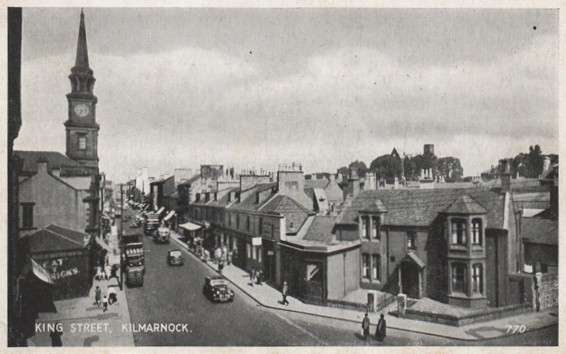 Image source: Frank Beattie
Architectural significance and community contributions
Designed by local architect Robert Johnstone, who also designed the Town House on King Street, the new church showcased a mix of architectural styles.
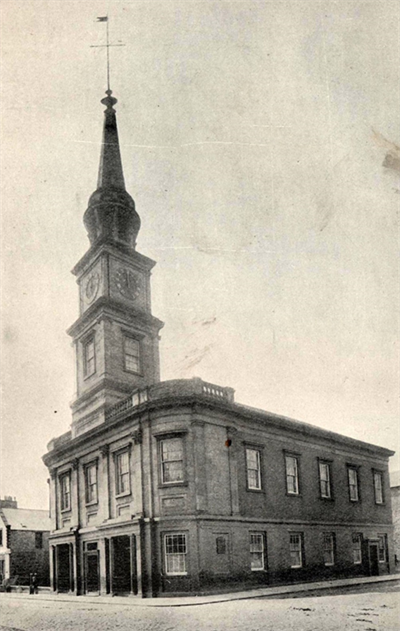
It boasted a magnificent, spacious interior as seen in this photograph.
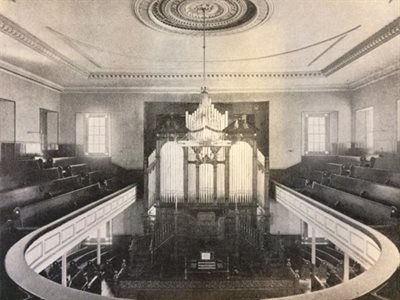
Community support was strong, with public funds helping to pay for the spire, bell, and clock, making the church not only a place of worship but a point of pride for the town.
A growing congregation and its leaders
Key moments in the church’s history included the installation of a pipe organ in 1894 and the appointment of Reverend Dr Thomas Whitelaw as Moderator of the Church of Scotland in 1911.
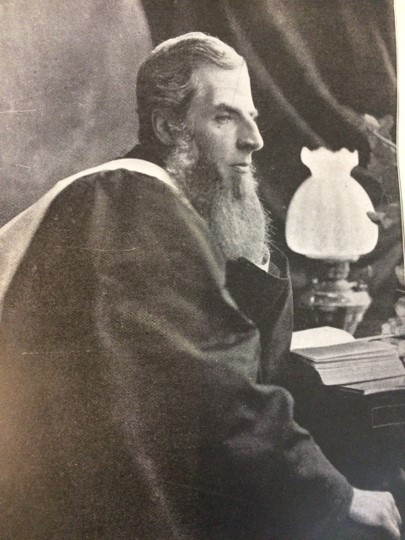
These milestones reflected both the congregation's internal growth and its increasing influence in the Scottish church.
Perhaps one of the King Street Church’s most famous ministers, the formidable Rev Dr Whitelaw, who had presided over the 1900 centenary celebrations, caused a stir when, in 1905, he took to his pulpit to protest against plans to run the trams past his establishment on a Sunday, and declared any such move “a calamity”.
One of the notable names in the Centenary Celebrations programme is that of Col Hugh Barnett, a local solicitor who was still riding his horse into work in the 1940s.
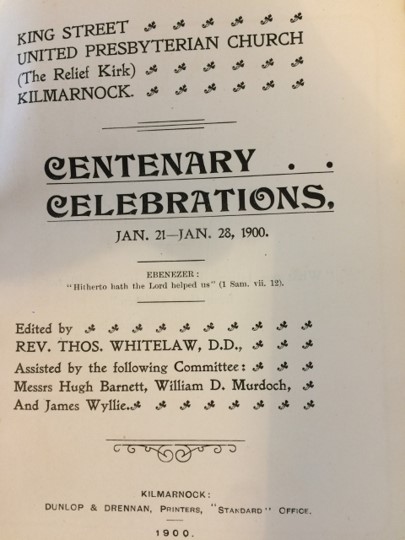
The Colonel took over what is thought to be Kilmarnock’s earliest law firm, dating from the late 18th century, and put his own name on it. Hugh Barnett and Co still exists nearby in his original Grange Place premises and is known today simply as Barnetts.
Neighbouring businesses
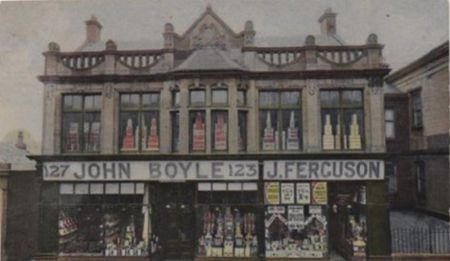
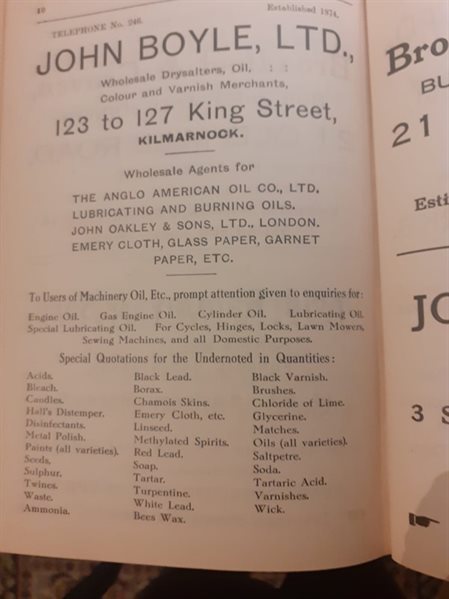
Among the other neighbouring businesses, John Boyle ran a very successful emporium for many years at 123-127 King Street, with an intriguing list of provisions available including such necessities as sulphur, tartaric acid, borax and saltpetre.
A street record
A Kilmarnock Directory record of the names and occupations of the properties inhabiting the block surrounding the church from 1882, 1198 and 1904 shows some interesting and varied businesses in the vicinity:
- King Street Church – The Reverend Dr Whitelaw
- 121 - James Kelly, Fishmonger
- 123 – John Boyle, Drysalter
- 125 – John Ferguson, Grocer
- 127 – WJ Mack & Co, Photographer; Mrs Humphrey
- 129 – Ting Tong Tea Co
- 133 - James Stevenson, Butcher
John McVail – eminent physician
Across the road from St Marnock Square is the site of the former Holmhead Medical practice. The surgery later moved to Portland Road.
This was where John McVail (22 October 1849 to 29 July 1926) had his practice. Born in Kilmarnock and educated at Kilmarnock Academy, he went on to graduate in Medicine from University of Glasgow in 1873 before gaining his Doctorate in 1875. He set up practice in Kilmarnock and was inspired by Henry Littlejohn to further his interest in Public Health and the application of statistics to the subject.
Going on to study at University of Cambridge he then became Medical Officer of Health for the Kilmarnock area before moving on to a more prominent position Stirlingshire and Dunbartonshire.
His groundbreaking work on cholera and vaccinations aside, he played an instrumental part getting the ball rolling with the foundation of the modern NHS when he helped to establish the National Health Insurance system in the UK.
The end of an era - demolition and legacy
In 1965, King Street Church and Portland Road Church merged, becoming the Howard Church in Portland Road.
The King Street Church building was sold, and in 1966, it was demolished, ending over a century of service. The funds from this sale supported the new Howard Church, allowing the legacy of the King Street congregation to continue.
From sacred space to commercial site
The site of the former King Street Church was redeveloped for commercial use, eventually housing several shops. For many years, a Mothercare store occupied the site, reflecting the changing face of Kilmarnock.
From commercial site to cultural corner
With spending habits changing once again, the need for so much retail space into the 21st century had decreased.
In the late 2010s Town Centre Regeneration Funding was allocated to demolish the outdated commercial centre, which housed the former Mothercare store, making way for a new green space in the middle of the town centre.
Tom Lightbody, worked with East Ayrshire Council and a local community group to install the Lady Anne Livingston Boyd Mural on the newly revealed gable end.
St Marnock Church - the Kirk's founding and funding
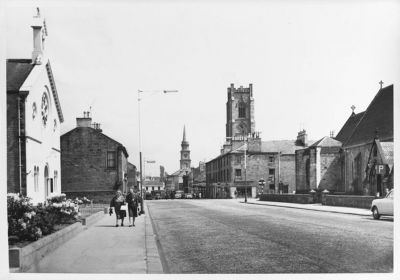 The instigation of St Marnock's Kirk, further up the road was made possible largely due to public subscriptions. Key contributors included Cunninghame of Caprington and William Paterson, a former attorney in Kingston, Jamaica.
After his passing in 1832, Paterson’s wealth, amassed through his career abroad, was legally contested. His will designated significant funds to his nephew and son, alongside a perpetual annual donation of £180 to Kilmarnock.
This gift was intended to support the town’s needy and promote educational achievements in local schools.
Image source: University of St Andrews: Portland Road and St Marnock Street, Kilmarnock
Architectural influence of James Ingram
Renowned architect James Ingram and his sons ran a successful practice which was based in John Finnie Street from 1895, in the building which now houses the Ingram Enterprise Centre. Following extensive tours of Europe, the team brought ideas from European architecture and brought it to bear using local materials such as the stunning red Ballochmyle Sandstone which was used in much of the construction of John Finnie Street.
Together they played a significant role in shaping Kilmarnock and wider East Ayrshire architectural landscape. Their contributions to local buildings, like St Marnock Church, the Opera House, the Dick Institute and Cumnock Town Hall, reflect their dedication to community-orientated designs which endure as integral elements of the area’s heritage.
St Marnock's Church and its historic bells
St Marnock’s Church in Kilmarnock houses bells crafted by the renowned Whitechapel Foundry, the same company responsible for famous bells like Pennsylvania's famous Liberty Bell and Big Ben.
The church’s historical ties to these significant cultural artifacts highlight its enduring role in Kilmarnock’s religious life.
Kilmarnock’s poetic legacy
While Kilmarnock is famously associated with Robert Burns, another literary figure, Reverend Dr John Conn, also brought poetic recognition to the town.
Appointed minister at St Marnock’s Church in 1942, Dr Conn’s son, Stewart Conn, later achieved fame as Edinburgh’s first official poet laureate (Makar) in 2002.
Stewart Conn’s time at Kilmarnock Academy marks an important link in the town’s cultural heritage.
Surrounding streetscapes
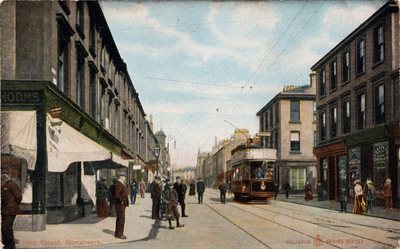 Kilmarnock Tramways - a bygone era
From 1904 to 1926, Kilmarnock Corporation Tramways operated throughout the town.
Although initially popular, (except when they ran on a Sunday in the eyes of Reverend Dr Whitelaw!), the trams were ultimately slow, uncomfortable, and expensive to maintain.
Following the General Strike of 1926, the tram service was discontinued, and infrastructure was removed.
Today, remnants of the tramway can still be seen in the form of fixtures which held the brackets for the wires on shop walls around Kilmarnock.
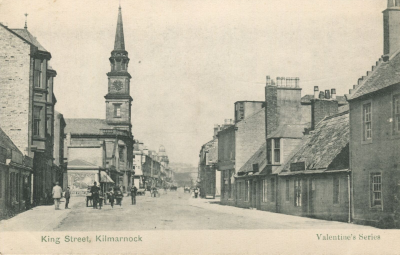
Historic Titchfield Street
Titchfield Street, formerly Titchfield Avenue, was once lined with thatched-roof houses that remained standing until the 1950s and 1960s.
Around 1900, the thatched roofs were replaced with slate.
A building with a distinct crow-stepped gable was later removed to make space for the Empire Picture House, which opened in 1913, marking the street’s transition and growth over time.
Photos not already credited are a collection from Graham Boyd’s presentation to the Kilmarnock & District History Group.